
The Dopamine Trap: Why Your Brain Craves “Get Rich Quick” Schemes (And How to Fight Back)
We’ve all been there.
You’re talking to a friend, and they mention a hot new stock, a crypto coin that’s “guaranteed to moon,” or a trading strategy that promises to make a month’s salary in a week.
You feel a jolt of excitement. A surge of FOMO (Fear Of Missing Out).
Suddenly, the sensible advice you’ve always heard (invest consistently in good assets for the long term) feels incredibly slow, boring, and outdated. The slow-and-steady path looks like a bullock cart, while the get-rich-quick scheme looks like a gleaming sports car.
Even when we know the sports car is likely to crash, why is the pull towards it so irresistible? Why do our brains seem to sabotage our own long-term financial success?
The answer isn’t a lack of willpower. The answer lies in our brain’s ancient wiring, and it revolves around a powerful chemical: dopamine.
Your Brain on the Stock Market: The Science of the Gamble
Our brains are not naturally wired for the modern stock market. They are wired for survival in a world of immediate cause and effect.
For millennia, our ancestors were rewarded with a dopamine hit for finding food (immediate reward) or escaping a predator (immediate survival).
Dopamine is the “reward chemical.” It’s released when we anticipate or experience something pleasurable, motivating us to repeat that behaviour.
Get-rich-quick schemes and speculative trading are the modern-day equivalent of a high-stakes hunt. They create a perfect dopamine loop:
- The Trigger: You hear about a new “opportunity.”
- The Action: You open your trading app and place a bet.
- The Reward (or Anticipation of it): The price moves. The screen flashes green. You anticipate a massive profit.
- The Dopamine Hit: Boom. Your brain releases dopamine, making you feel excited, powerful, and alive.
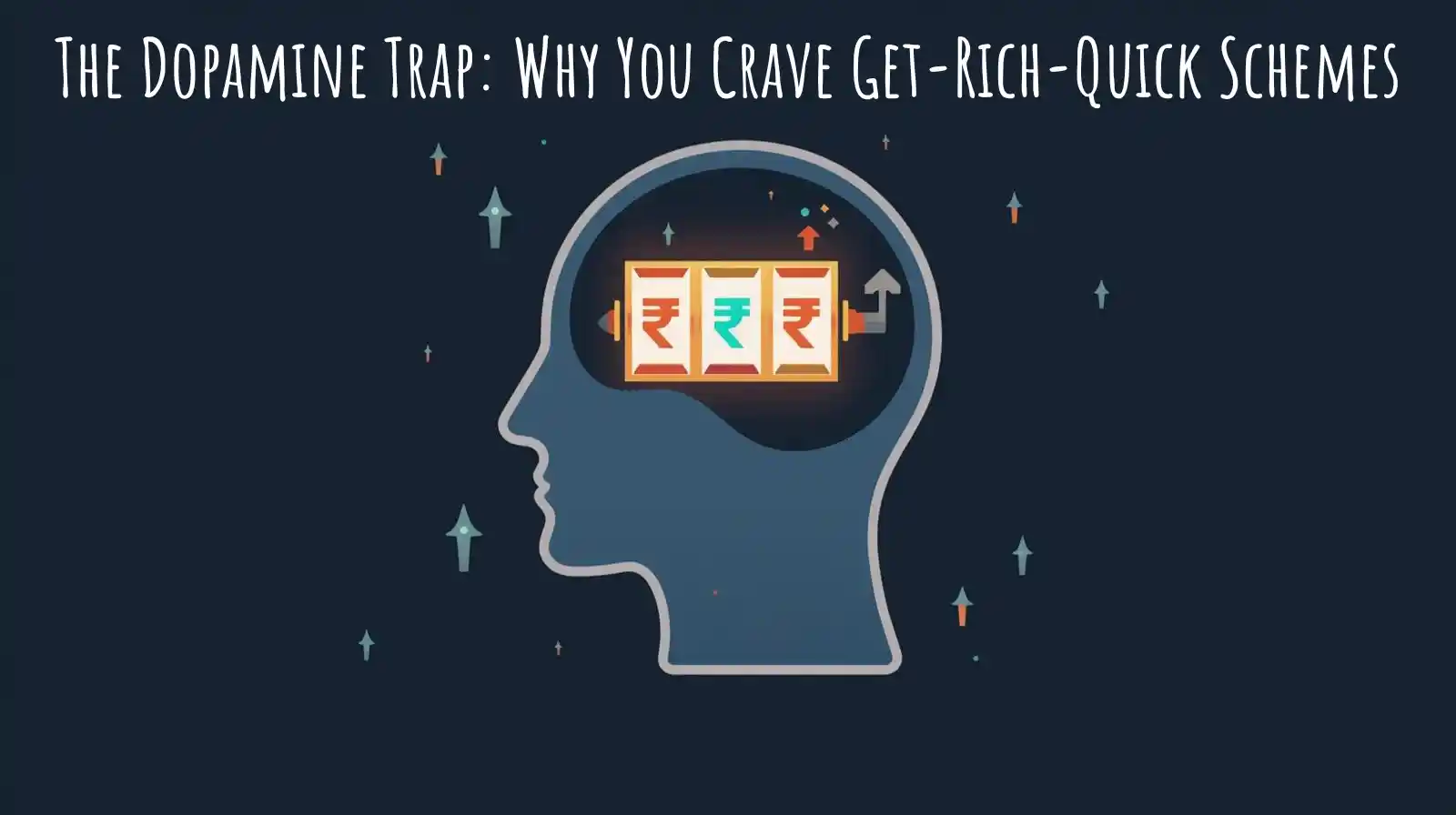
This loop is powerfully addictive. Trading apps are designed like slot machines, with their flashing colours, instant notifications, and the satisfying “ding” of a trade being executed. Each trade is a pull of the lever, and each price movement is a spin of the wheels.
This is the very essence of the Shiny Object Syndrome. Our brain isn’t actually seeking wealth; it’s seeking the next dopamine hit from the possibility of wealth. A new trading strategy is just a new, more exciting slot machine.
Add to this a jolt of adrenaline (the “fight or flight” hormone released during risky situations), and you have a chemical cocktail that makes slow, patient investing feel completely unappealing.
How to Rewire Your Brain for Long-Term Wealth
If you’re fighting against your own brain chemistry, you can’t win with willpower alone. You have to win with strategy. You need to create a new system that works with your brain, not against it.
Here are four practical steps to break free from the dopamine trap.
1. Acknowledge the Game
The first step is simple awareness. The next time you feel the urge to jump on a “hot tip,” pause and name what’s happening. Say to yourself, “This is my brain seeking a dopamine hit, not a sound investment.” By identifying the impulse, you take away its power. You shift from being a player in the game to an observer.
2. Automate the Sensible Path
The single most powerful tool against emotional investing is automation. Dopamine is triggered by action and decision-making. If you remove the decision, you break the loop. Set up a Systematic Investment Plan (SIP) for your mutual funds and automatic transfers to your investment account. This forces you to invest consistently, whether the market is exciting or boring. It’s the ultimate “set it and forget it” strategy that starves the dopamine-seeking part of your brain.
3. Change Your Reward System
You need to replace the short-term thrill of a trade with the long-term satisfaction of progress. Stop checking your portfolio daily. Instead, schedule a “Wealth Review” once every three or six months. The reward is no longer a flashing green number on a screen; it’s seeing a chart of your net worth steadily climbing over time. This new ritual creates a healthier, more meaningful dopamine release tied to genuine progress, not gambling.
4. Find a New “Game”: The Thrill of Understanding
The urge for excitement is real, but it doesn’t have to be satisfied by gambling. Instead of fighting it, redirect it. Turn the intellectual challenge of finding and understanding a great business into your new “game.” The next time you have 30 minutes, instead of opening a trading app, open a company’s annual report. Read about its business model, its leaders, or its competition. The “reward” you’re seeking is no longer the thrill of a price change, but the “aha!” moment of truly understanding why a business is a great long-term investment. This shifts the dopamine hit from speculation to wisdom.
Winning Your Second Innings
True financial freedom isn’t found in the heart-pounding thrill of a risky trade. It’s found in the quiet confidence of a well-laid plan. It’s about understanding the games your brain wants to play and building a system to ensure you win the one that actually matters.
By acknowledging the dopamine trap and implementing a disciplined strategy, you can get off the emotional rollercoaster and onto the steady, upward path of genuine wealth creation.
Ready to build that plan? This article explains the “why.” To learn the “how,” read my complete Manage Money Pillar Page for the full blueprint on building lasting financial freedom.